

Restriction on re-use of company names
Section 216 of the Insolvency Act 1986 (as amended) (“the Act”) stops directors of companies in Liquidation from re-using the same or a similar name to start or run another business, unless they get court permission or fit into narrow exceptions. Section 217 of the Act makes directors personally liable for debts if they ignore this requirement.
Part 22 of the the Insolvency (England and Wales) Rules 2016 (“the Rules”) explains how to obtain permission or use exceptions lawfully.
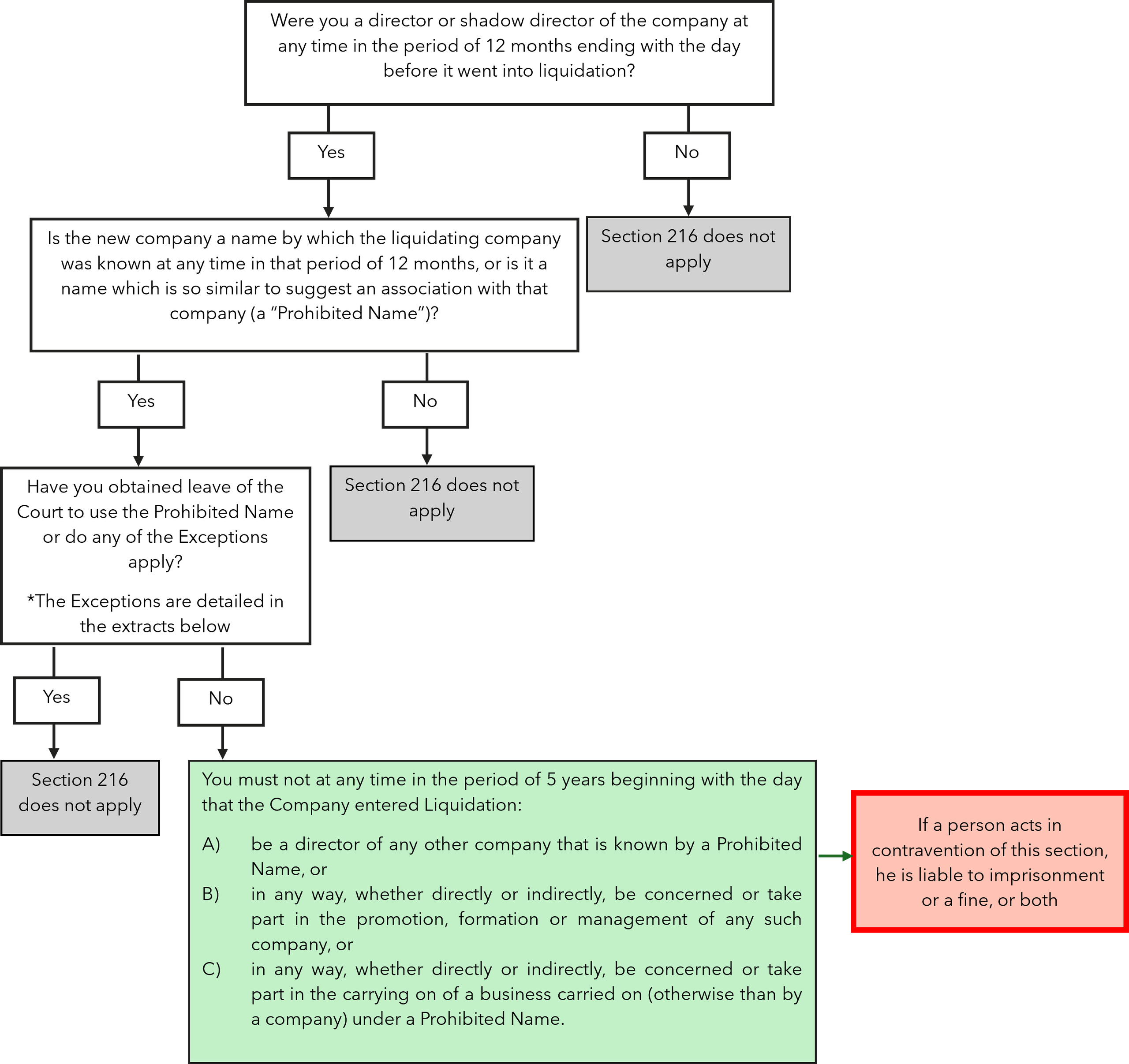
The flow chart below is a high-level summary of key aspects of the Act and the Rules but it is advised that you review them in detail if you are concerned that they will apply.
Extracts of the relevant legislation from the Act
Section 216 of the Act
(1) This section applies to a person where a Company (“the liquidated Company”) has gone into insolvent liquidation on or after the appointed day and he was a director or shadow director of the Company at any time in the period of 12 months ending with the day before it went into liquidation.
(2) For the purposes of this section, a name is a prohibited name in relation to such a person if –
(a) it is a name by which the liquidated Company was known at any time in that period of 12 months, or
(b) it is a name which is so similar to a name falling within paragraph (a) as to suggest an association with that Company
(3) Except with leave of the Court or in such circumstances as may be prescribed, a person to whom this section applies shall not at any time in the period of 5 years beginning with the day on which the liquidated Company went into liquidation –
- be a director of any other company that is known by a prohibited name, or
- in any way, whether directly or indirectly, be concerned or take part in the promotion, formation or management of any such company, or
- in any way, whether directly or indirectly, be concerned or take part in the carrying on of a business carried on (otherwise than by a company) under a prohibited name.
(4) If a person acts in contravention of this section, he is liable to imprisonment or a fine, or both.
(5) In subsection (3) “the Court” means any Court having jurisdiction to wind up companies; and on an application for leave under that subsection, the Secretary of State or the Official Receiver may appear and call the attention of the Court to any matters which seem to him to be relevant.
(6) References in this section, in relation to any time, to a name by which a company is known are to the name of the company at that time or to any name under which the company carries on business at that time.
(7) For the purposes of this section a company goes into insolvent liquidation if it goes into liquidation at a time when its assets are insufficient for the payment of its debts and other liabilities and the expenses of the winding up.
(8) In this section “company” includes a company which may be wound up under Part V of this Act.
Section 217 of the Act
(1) A person is personally responsible for all the relevant debts of a company if at any time –
(a) in contravention of section 216, he is involved in the management of the company, or
(b) as a person who is involved in the management of the company, he acts or is willing to act on instructions given (without the leave of the court) by a person whom he knows at that time to be in contravention in relation to the company of section 216.
(2) Where a person is personally responsible under this section for the relevant debts of a company, he is jointly and severally liable in respect of those debts with the company and any other person who, whether under this section or otherwise, is so liable.
(3) For the purposes of this section the relevant debts of a company are –
- in relation to a person who is personally responsible under paragraph (a) of subsection (1), such debts and other liabilities of the company as are incurred at a time when that person was involved in the management of the company, and
- in relation to a person who is personally responsible under paragraph (b) of that subsection, such debts and other liabilities of the company as are incurred at a time when that person was acting or was willing to act on instructions given as mentioned in that paragraph.
(4) For the purposes of this section, a person is involved in the management of a company if he is a director of the company or if he is concerned, whether directly or indirectly, or takes part, in the management of the company.
(5) For the purposes of this section a person who, as a person involved in the management of a company, has at any time acted on instructions given (without the leave of the court) by a person whom he knew at that time to be in contravention in relation to the company of section 216 is presumed, unless the contrary is shown, to have been willing at any time thereafter to act on any instructions given by that person.
(6) In this section “company” includes a company which may be wound up under Part V.
Part 22 of the Rules
Preliminary
22.1.—(1) The rules in this Part:
- relate to permission required under section 216 (restriction on re-use of name of company in insolvent liquidation) for a person to act as mentioned in section 216(3) in relation to a company with a prohibited name;
- prescribe the cases excepted from that provision, that is to say, in which a person to whom the section applies may so act without that permission; and
- apply to all windings up to which section 216 applies.
Application for permission under section 216(3)
22.2.—(1) At least 14 days’ notice of any application for permission to act in any of the circumstances which would otherwise be prohibited by section 216(3) must be given by the applicant to the Secretary of State, who may:
- appear at the hearing of the application; and
- whether or not appearing at the hearing, make representations.
Power of court to call for liquidator’s report
22.3.When considering an application for permission under section 216, the court may call on the liquidator, or any former liquidator, of the liquidating company for a report of the circumstances in which the company became insolvent and the extent (if any) of the applicant’s apparent responsibility for its doing so.
First excepted case
22.4.—(1) This rule applies where:
- a person (“the person”) was within the period mentioned in section 216(1) a director, or shadow director, of an insolvent company that has gone into insolvent liquidation; and
- the person acts in all or any of the ways specified in section 216(3) in connection with, or for the purposes of, the carrying on (or proposed carrying on) of the whole or substantially the whole of the business of the insolvent company where that business (or substantially the whole of it) is (or is to be) acquired from the insolvent company under arrangements:
- made by its liquidator, or
- made before the insolvent company entered into insolvent liquidation by an officeholder acting in relation to it as administrator, administrative receiver or supervisor of a CVA.’
(2) The person will not be taken to have contravened section 216 if prior to that person acting in the circumstances set out in paragraph (1) a notice is, in accordance with the requirements of paragraph (3):
- given by the person, to every creditor of the insolvent company whose name and address:
- is known by that person, or
- is ascertainable by that person on the making of such enquiries as are reasonable in the circumstances; and
- published in the Gazette
(3) The notice referred to in paragraph (2):
- may be given and published before the completion of the arrangements referred to in paragraph (1)(b) but must be given and published no later than 28 days after their completion;
- must contain:
- identification details for the company,
- the name and address of the person,
- a statement that it is the person’s intention to act (or, where the insolvent company has not entered insolvent liquidation, to act or continue to act) in all or any of the ways specified in section 216(3) in connection with, or for the purposes of, the carrying on of the whole or substantially the whole of the business of the insolvent company,
- the prohibited name or, where the company has not entered into insolvent liquidation, the name under which the business is being, or is to be, carried on which would be a prohibited name in respect of the person in the event of the insolvent company entering insolvent liquidation,
- a statement that the person would not otherwise be permitted to undertake those activities without the leave of the court or the application of an exception created by Rules made under the Insolvency Act 1986,
- a statement that breach of the prohibition created by section 216 is a criminal offence, and
- a statement as set out in rule 22.5 of the effect of issuing the notice under rule 22.4(2);
- where the company is in administration, has an administrative receiver appointed or is subject to a CVA,
- the date that the company entered administration, had an administrative receiver appointed or a CVA approved (whichever is the earliest), and
- a statement that the person was a director of the company on that date; and
- where the company is in insolvent liquidation:
- the date that the company entered insolvent liquidation, and
- a statement that the person was a director of the company during the 12 months ending with that date.
(4) Notice may in particular be given under this rule:
- prior to the insolvent company entering insolvent liquidation where the business (or substantially the whole of the business) is, or is to be, acquired by another company under arrangements made by an office-holder acting in relation to the insolvent company as administrator, administrative receiver or supervisor of a CVA (whether or not at the time of the giving of the notice the person is a director of that other company); or
- at a time when the person is a director of another company where:
- the other company has acquired, or is to acquire, the whole, or substantially the whole, of the business of the insolvent company under arrangements made by its liquidator, and
- it is proposed that after the giving of the notice a prohibited name should be adopted by the other company.
(5) Notice may not be given under this rule by a person who has already acted in breach of section 216.
Statement as to the effect of the notice under rule 22.4(2)
22.5.The statement as to the effect of the notice under rule 22.4(2) must be as set out below:
“Section 216(3) of the Insolvency Act 1986 lists the activities that a director of a company that has gone into insolvent liquidation may not undertake unless the court gives permission or there is an exception in the Insolvency Rules made under the Insolvency Act 1986. (This includes the exceptions in Part 22 of the Insolvency (England and Wales) Rules 2016.) These activities are:
- acting as a director of another company that is known by a name which is either the same as a name used by the company in insolvent liquidation in the 12 months before it entered liquidation or is so similar as to suggest an association with that company;
- directly or indirectly being concerned or taking part in the promotion, formation or management of any such company; or
- directly or indirectly being concerned in the carrying on of a business otherwise than through a company under a name of the kind mentioned in (a) above.
This notice is given under rule 22.4 of the Insolvency (England and Wales) Rules 2016 where the business of a company which is in, or may go into, insolvent liquidation is, or is to be, carried on otherwise than by the company in liquidation with the involvement of a director of that company and under the same or a similar name to that of that company.
The purpose of giving this notice is to permit the director to act in these circumstances where the company enters (or has entered) insolvent liquidation without the director committing a criminal offence and in the case of the carrying on of the business through another company, being personally liable for that company’s debts. Notice may be given where the person giving the notice is already the director of a company which proposes to adopt a prohibited name.”
Second excepted case
22.6.—(1) Where a person to whom section 216 applies as having been a director or shadow director of the liquidating company applies for permission of the court under that section not later than seven business days from the date on which the company went into liquidation, the person may, during the period specified in paragraph (2) below, act in any of the ways mentioned in section 216(3), notwithstanding that the person does not have the permission of the court under that section.
(2) The period referred to in paragraph (1) begins with the day on which the company goes into liquidation and ends either on the day falling six weeks after that date or on the day on which the court disposes of the application for permission under section 216, whichever of those days occurs first.
Third excepted case
22.7.The court’s permission under section 216(3) is not required where the company there referred to though known by a prohibited name within the meaning of the section:
- has been known by that name for the whole of the period of 12 months ending with the day before the liquidating company went into liquidation; and
- has not at any time in those 12 months been dormant within the meaning of section 1169(1), (2) and (3)(a) of the Companies Act.
Should the best offer be received from a connected party, the Administrators will be unable to execute the sale within the first eight weeks of appointment unless either the creditors agree to the sale or the purchaser obtains a Qualifying Report from an independent Evaluator. The purpose of this report is to objectively assess the fairness of the transaction.