



eDiscovery
When it comes to responding to a legal matter, time is of the essence, and many disputes now require many thousands of electronic documents and emails to be reviewed and assessed before disclosure to opposing counsel and court.
Our eDiscovery & Forensic Technology Services

eDiscovery

Document Review

Data Collection

Data Analysis

Data Recovery

Digital Forensics

Technology Assisted Review

Generative AI
eDiscovery Support from Data Collection to Disclosure
Using the latest eDiscovery search and review tools, the number of documents to be reviewed is significantly reduced, resulting in a process that is quicker and more cost effective.
Our experts can assist at all stages of an eDiscovery exercise, from identifying, collecting and preserving initial data, through to document review and production.
Not only do we provide a software platform, but we actively manage the process throughout, helping you to find the best workflow, assisting with the searching and foldering stages, providing ‘Technology Assisted Review’ and ‘Generative AI’ workflows as required and, in the latter stages, ensuring that relevancy, privilege and tagging is fully considered before creating a final disclosure set.
Whilst outside counsel takes the reins of the document review, and can be as ‘hands on’ as required in the management of the platform, we can assist with the more technical aspects of the engagement drawing upon the expertise of our in-house forensic accounting, asset recovery and investigation specialists.
A Review Platform Powered by Best-in-Class Technology
Our document review platform is powered by Reveal and offers a full suite of eDiscovery solutions in one seamless platform. Harnessing the latest in AI technology to get to the salient data as quickly and cost-effectively as possible, Reveal is now the platform of choice in over 40 countries (incorporating Machine Learning, Auto Translation/Transcription, Sentiment Analysis, Image Analysis, Concept Grouping, Generative AI and much more).
As we maintain the review environment in-house, we offer the most competitive and visible pricing at the outset without charging for processing or users, therefore allowing for easy costs budgeting.
Key stages in our process
Typical eDiscovery engagements we work on involve a combination of the following:
- Identification – initial scoping advice, to ascertain where the data resides and how best to collect it
- Preservation – advice on the most appropriate way to preserve client data, prior to collection
- Collection – our digital forensics team collect and retrieve data from a wide variety of sources such as laptops, desktops, server/network shares, smartphones, webmail (e.g. Office365, Gmail), and instant messaging/collaboration systems such as Slack and Teams
- Processing – consolidating and processing data for import into the review platform
- Analysis – analysing and streamlining data based on client needs and utilising the AI, Machine Learning and translation capabilities of our review platform (See our ‘AI Enhanced’ Investigations page)
- Review – supporting legal advisors with detailed and changeable document review stages
- Production – exporting the ‘disclosure’ in any format for the opposing counsel
In summary, our experienced team, combined with the latest technology, can provide the most comprehensive and cost- effective solution to investigations and disputes.
AI Enhanced Investigations
As data volumes become greater, and investigations become more sophisticated in scope and scale, reviewing documents in a traditional way can become disproportionate to the matter at hand, or even impossible within the necessary timescales.
Our eDiscovery team utilises cutting edge technology to identify and target key areas at an early stage, ensuring key data is secured and resources targeted appropriately. We load relevant data onto our review platform early in the investigation and then leverage the power of our advanced investigation tools for advanced analytics and concept searching – also termed ‘Technology Assisted Review’ (TAR) or ‘Augmented Intelligence’ (AI).
The technology is designed to ‘Augment not Replace’ experts and the document review workflows. It effectively targets key documents, based on initial information, and refines and learns as the matter progresses.
Not all cases will benefit from TAR or AI, but those that do will often see significant time and cost savings. In addition, the Disclosure Review Document (DRD) used during case management conferences explicitly asks the question as to whether TAR has been considered for the matter and, if not, the reasons why.
AI and Technology Assisted Review Tools
TAR or AI use a range of techniques to filter, segment and review the documents and emails of relevance, as follows:
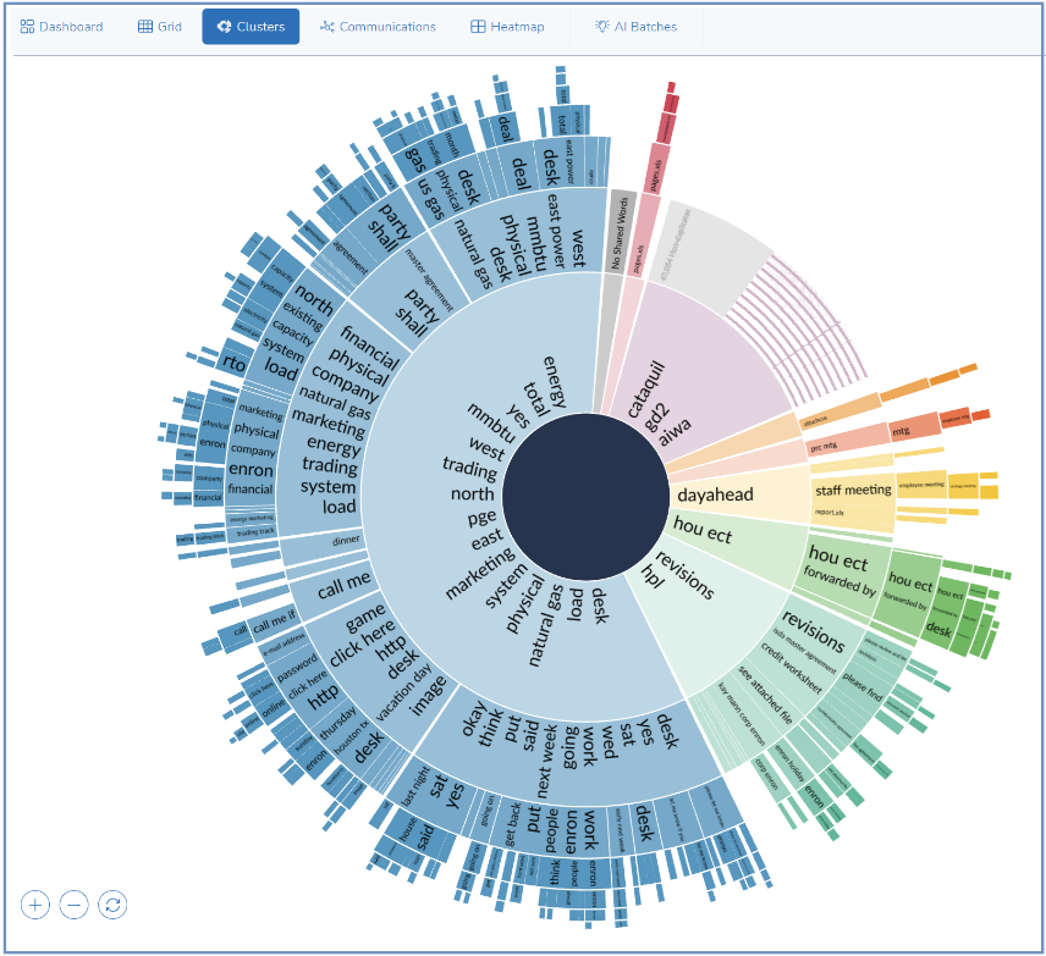
- Concept Searching – either ‘supervised’ whereby the user provides the system with phrases, paragraphs or documents and effectively asks it to ‘find me more like these’, or ‘unsupervised’ where the system automatically generates ‘cluster groups’ that contain similar content for review
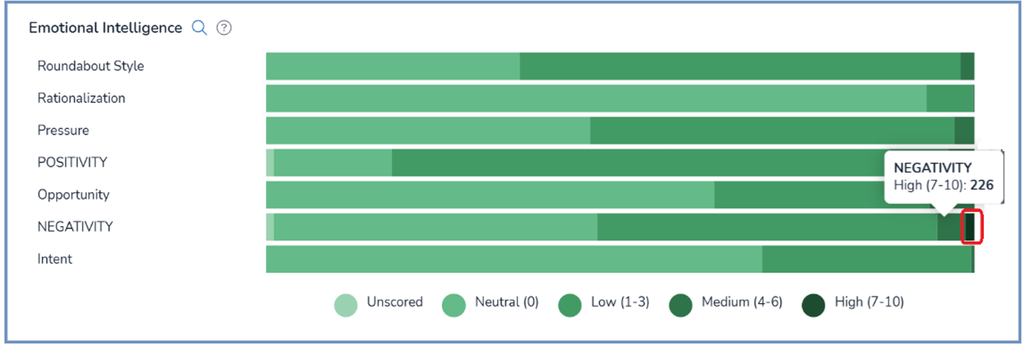
- Sentiment Analysis – words, phrases, capitalised words or relational words are used to analyse the mood of the email, for example ‘angry emails’, and these can be combined with other filters e.g. ‘angry emails, mentioning keywords/concepts X+Y, sent outside of work hours’
- Communication Analysis – a searchable visual tool for assessing topics of communication between different individuals, to look for patterns or unusual activity e.g. emails to an unknown external address
- Image Identification and Labelling – the system will analyse the image and label it with suggestions such as ‘Construction Site’, ‘Man at ATM’, ‘Man, Car, Shopping’, ‘Documents/Scans’
- Machine Learning – the system analyses documents that have been reviewed by a human reviewer, looks for patterns in the textual content and underlying metadata, and then presents the user with groups of documents in folders according to their ‘Likely Relevance Rank’
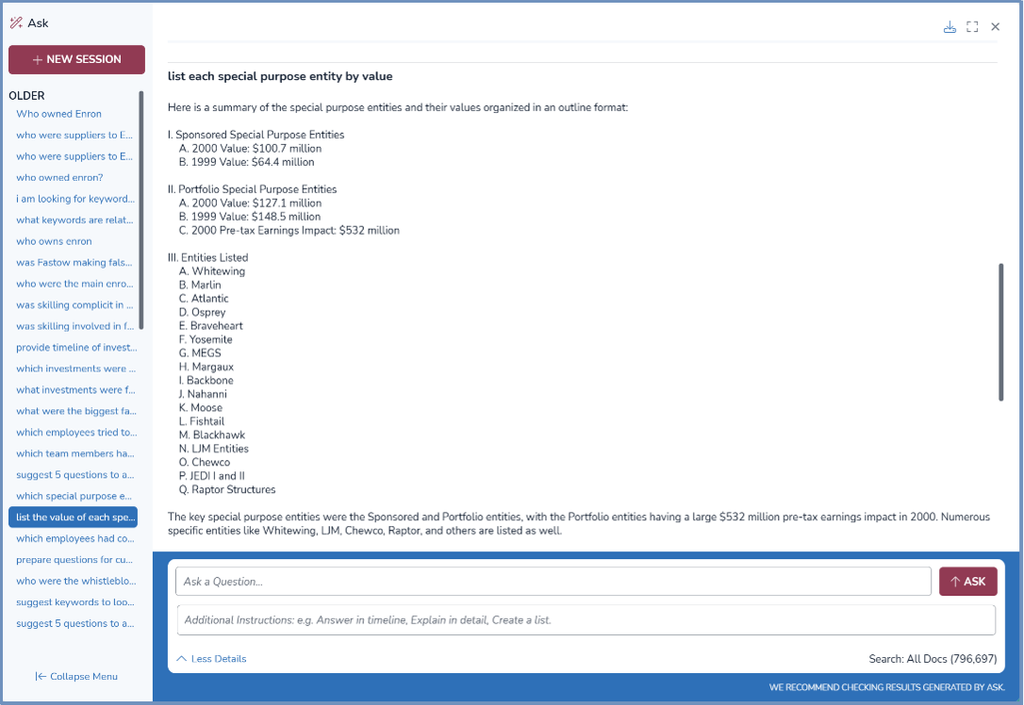
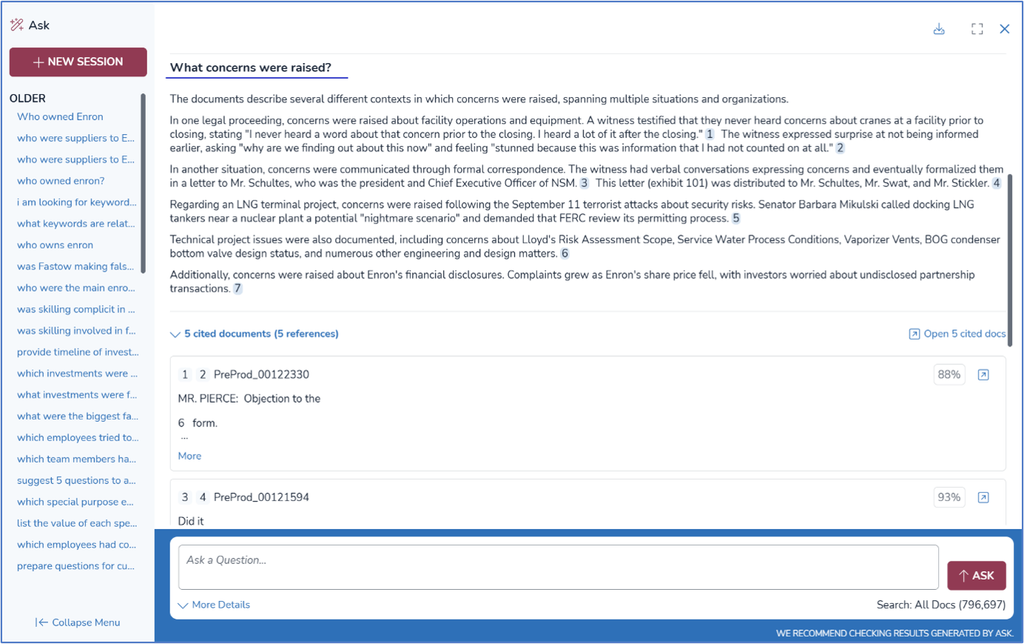
- ‘Generative AI’ – the user can simply type questions, with the system analysing the question, interrogating all text within all documents, and then providing a ‘natural language’ answer e.g. “which company directors were present at meetings to discuss investing in Company X?”
The platform incorporates multiple easy-to-navigate sections, allowing our team (or the legal advisors/client) to quickly utilise the features that best match the matter type. Below are a selection of screenshots to illustrate the graphical user interfaces, and provide better insight into how the features work:
All matters are different, and all technology is only as good as the user piloting it, so we employ standard sensible workflows at the outset, and then augment them with whichever functionality best matches requirements.
For a live demonstration of the tools used, to discuss your requirements or if you have any questions, please contact Ben Hammerton who leads our AI Enhanced Investigations team.
Forensic Technology
Our experts secure and analyse data in a forensically sound manner, such that it can then be used in evidence or in support of an investigation.
Computers, mobile phones and other digital storage media hold a vast amount of data. Even though many businesses now strive to be paperless, and communication is invariably through email, securing such data is often overlooked, which can cause potentially valuable information to be lost.
We cannot stress enough how important it can be to preserve and protect digitally held data at the earliest possible opportunity when a potential dispute or investigation need arises.
Our experts have considerable experience of securing and analysing data in a forensically sound manner, such that it can then be used in evidence or in support of an investigation. Using specialist forensic software, we can efficiently review vast amounts of information and present our findings in a useable and targeted format.
We look well beyond readily detectable data, identifying deleted items and/or information that would not be available without the use of specialist software. We often recover information that a lay person might not even know, realise or expect to be there.
We utilise a variety of tools to allow us to collect data ‘physically’ (connecting directly to the device – necessary for SMS messages), or ‘remotely’ (connecting to cloud storage such as Office 365).
Although we regularly accept instructions in cases with no financial aspect, we add value and differentiate ourselves where there is. Our team also specialises in forensic accounting, and we can therefore go well beyond keywords, file types, date ranges etc, when reviewing data. We regularly analyse and identify data in conjunction with corresponding accounting work. In this way, as accountants, we do not need to rely on others to interpret and identify financial information.
Similarly, by using specialist software we are also able to undertake data mining exercises, identifying and interpreting patterns, anomalies, correlations and exceptions within large datasets. These methods and techniques can quickly target key areas and can significantly reduce the amount of time it takes to get to the answer.
Types of Forensic Technology Work
Types of forensic technology work that we undertake include:
- Computer forensic analysis – securing and analysing digital data in a forensically sound manner
- Employment matters/disputes – e.g., examining computer hard drives for evidence of intellectual property theft
- Recovering deleted files and emails
- Search and seizure exercises
- Examining computers on behalf of internal and external insolvency teams, identifying and extracting relevant financial data in a form that can be readily interpreted/exhibited.
- Gaining access to information within encrypted files
- Data mining
How KR8’s eDiscovery team can help you
Our approach is to provide pragmatic and commercial advice, with our senior team members maintaining a high level of involvement in cases. Our team has the experience and expertise to make a difference.
We are well placed to assist at all stages of an eDiscovery exercise, from identifying and preserving initial data, to document review and production. If you would like to see how our eDiscovery service will benefit your cases, please get in touch with Ben Hammerton who leads our eDiscovery team.

How KR8’s Business Advisory team can help you
We work closely with stakeholders to get businesses back on track.
Whether demand for a product has fallen, an investment has not worked out as expected, or a company needs help defining its future strategy, our team — comprised of accountants, industry executives and former financial services professionals — has the expertise to make a difference.
In addition to working with management teams, our Business Advisory colleagues also support lenders and sponsors in managing investment or repayment strategies, particularly when financial risks are high.