




The FCA’s recent consultation on crypto asset disclosures and market abuse marks the latest stage in its roadmap for bringing cryptocurrencies and other digital assets into its regulatory perimeter. However, there is still a long way to go before the rules are finalised. Even when they are finalised, this will remain an unfamiliar and often challenging frontier. How might new crypto transparency rules help creditors, lawyers and insolvency practitioners? What are the key priorities in securing and recovering crypto assets in an insolvency?
Cryptocurrencies are rarely out of the news. They are delivering fresh sources of liquidity and continuous trading opportunities, while being able to operate around the clock and without geographical boundaries. Their move into the financial mainstream has been accelerated by the backing of the new US administration and the gradual easing of restrictions around the globe, including in the UK.
For businesses, cryptocurrencies, non-fungible tokens (NFTs) and other digital assets can enhance the ease, speed and secure validation of transactions. Companies might also hold cryptocurrencies as investments or collateral on a loan. Further applications range from automated payment triggers in insurance contracts to the growing use of NFTs to certify ownership and authenticity of valuable assets such as artworks or copyrighted designs. As a result, digital assets are now an ever-growing element of the asset mix, either directly or in relation to key counterparties.
Heightened risk of fraud, misappropriation and dissipation
With the growing prevalence of digital assets comes increased risks. A lot of the focus has centred around fraudulent activities within crypto exchanges. Infamous cases such as the 2022 collapse of Sam Bankman-Fried’s FTX crypto exchange have highlighted the labyrinthine complexities and multinational reach of some of the structures involved, which can severely hamper investigation and asset tracing during restructuring and insolvency.
Further questions centre on security and control. Asset holders can opt for a custodial or non-custodial wallet. With non-custodial wallets, the owner takes responsibility for storing and protecting the private key against cyber and physical threats. With custodial wallets, a third-party such as an exchange manages the private keys for the client. Custodianship should in theory offer greater protection against hacking and other security threats. However, the FTX collapse has led some owners to worry about what would happen if the exchange turned out to be a fraudulent operation.
Crucially, the challenges for creditors, lawyers and insolvency practitioners go much further than the failure of a crypto exchange. As we explore in our article Tracing and recovering misappropriated digital assets, the decentralised and effectively borderless nature of cryptocurrency and other digital assets can increase the risk of fraud, theft and loss by enabling ‘bad actors’ to use pseudonyms or private exchanges to move money around and cover their tracks. In the event of an insolvency, debtors could also try to deny ownership or withhold the private keys needed to access the assets.
Seeking regulatory balance
As the deployment and risks associated with digital assets increase, there is a growing need for the development of suitable regulatory frameworks to protect consumers. Many countries are developing and implementing new regulations. In Cyprus, for example, which has become a major hub for cryptocurrency exchanges, the country’s financial regulator is one of those leading the way by issuing a comprehensive policy statement outlining fee structures and reporting requirements under the Markets in Crypto-Assets Regulation.
Important developments in the UK include legislation designed to clarify crypto’s status as personal property and hence be included in a debtor’s estate. This designation should therefore make it easier for digital assets to be identified, valued and distributed to creditors. However, other jurisdictions might take a different view by classifying digital assets as either financial securities, legal tender or contractual obligations.
The UK Financial Conduct Authority’s (FCA) moves to bring digital assets into the regulatory net seek to strike a balance between the growing demand and pace of innovation in this area with what is palatable to the public.
The FCA’s crypto roadmap sets out a phased approach to regulatory development. Right now, regulations are largely confined to anti-money laundering. The resulting information is helpful for insolvency practitioners making enquiries and looking to source data from crypto exchanges. The recent discussion paper aims to take this further by focusing on admissions, disclosures and market abuse. Of particular importance to creditors, lawyers and insolvency practitioners are the requirements on due diligence, information sharing and checks on the issuer, which should not only improve the vetting of these assets, but also their traceability. However, we could be well into 2026 before the rules proposed in the discussion paper are finalised and implemented.
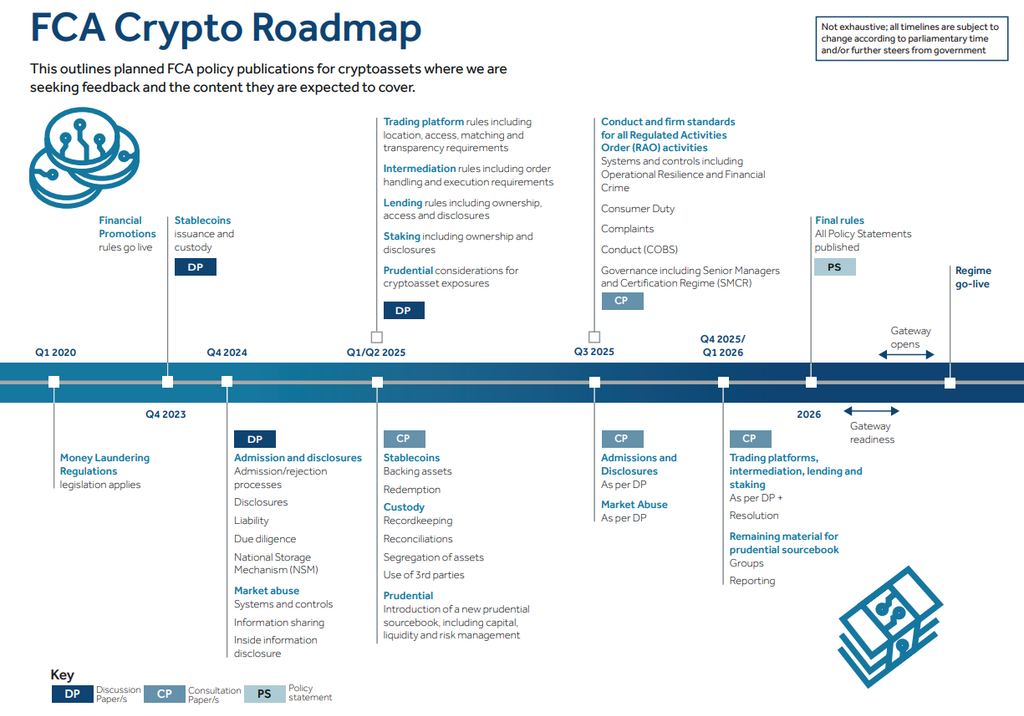
Source: FCA website
DP24/4: Regulating crypto assets – Admissions & Disclosures and Market Abuse Regime for Crypto assets
Moreover, key areas of interest for creditors, lawyers and insolvency practitioners, including conduct, custody and segregation of assets, have been largely deferred to future FCA discussion and consultation papers.
Evolving challenges
Although cryptocurrency and other digital assets are deemed to be property, the ownership of crypto assets is often not clear. Key challenges include determining who has the proprietary right to the property, and identifying the debtor and their relationship with the crypto assets.
Further issues to be resolved include the status of digital assets held by custodians. If the custodial arrangement is legally recognised, the assets would be segregated and returned to the client if the custodian or wallet provider goes into insolvency. However, variations in the structures, operations and asset holding terms of the crypto custodianship mean that the segregated status could be subject to legal challenge. The waters have been muddied still further by the emergence of a hybrid custodianship option in which the funds are held by a third-party provider, but the owner retains control over the private keys in the same way as a non-custodial wallet.
Key priorities for any new regulation should therefore include establishing:
- a clear-cut foundation for the proprietary rights over digital assets in the event of an insolvency,
- appropriate rules on custodial segregation, and
- the qualifications for segregation in an insolvency
Underlying priorities include ensuring that any potential conflicts of interest between client and custodian are adequately addressed.
Ultimately, digital assets present distinct challenges to insolvency practitioners whatever the rules in place, not least because of the volatility of the value of crypto assets and the basis upon which an insolvency practitioner will determine the value at the date of sale.
Insolvency priorities
So how can clients dealing with restructuring, insolvency and asset recovery tackle the distinct challenges opened up by the presence of digital assets? Four priorities stand out:
- Build in crypto
As part of their remit, insolvency practitioners now need to take active steps to establish the potential presence of cryptocurrency and other digital assets. The value of crypto assets is by nature volatile, which can have a material impact on the potential realisations from an insolvent estate. Some crypto assets may not fall into the legal definition of currency, which means that the circumstances of any case will determine whether there is an obligation to convert crypto asset into fiat currency or whether there should be a distribution of the crypto asset in kind. The involvement of cryptocurrency and other digital assets could therefore increase the complexity of an insolvency case. - Move quickly
The speed with which digital assets can be transferred and potentially dissipated makes it vitally important to move quickly to identify the existence of these assets and trace the controlling wallets, ahead of applying for a freezing order and taking ownership of the assets. This tracing exercise may well require expert support, especially if holders seek to hide the assets or withhold the access keys. - Dig deeper
One way or another, most digital assets can be traced. While the nature of many blockchain networks give blockchain users a higher degree of privacy compared to traditional financial systems, most operate on blockchains that show information such as the sender, recipient and amount.Clearly, asset tracing can be hampered by attempts to obscure ownership. However, there are a growing number of techniques that specialist forensic investigators can use to trace and uncover misappropriated digital assets. Even the ‘dark web’ can be penetrated by an experienced investigator using the latest tech tools. - Make sure that regulatory developments reflect insolvency and restructuring priorities
Many of the challenges facing insolvency practitioners centre on the fact that even when assets can be identified via crypto wallets or held by crypto custodians, there is currently limited insolvency guidance on how to realise these assets through crypto dealers or exchanges.Naturally, regulatory developments are primarily focused on retail investor protection. Given the challenges highlighted above, however, it is also important for professionals working in restructuring and insolvency to have their say to ensure that the unfolding rules reflect their priorities in areas such as clearer registration of ownership, clarification of custodial status and enforcement of court orders.
Here to help
Quantuma is working closely with clients and professional bodies to track and help inform regulatory developments relating to cryptocurrencies, NFTs and other digital assets. A key part of our work as insolvency practitioners also includes helping lawyers and creditors trace digital assets and assemble supporting evidence for freezing orders and other court actions. Our support draws on our use of the latest tech-enabled forensic investigation. If you would like to discuss any of the issues raised in this article, please get in touch.
Dina Devalia
Managing Director
dina.devalia@kr8.co.uk